
By Alan J. Klingensmith | The Leadership Lab
A few weeks ago, the Good News Network ran a story I can’t stop thinking about. It came out of the San Francisco area. Two teenage brothers, Desmond and Ethan Hua, were just going to school like everybody else. Normal kids. Normal day. Until they noticed something.
There was a boy at their school wearing shorts on a cold day.
That was it. That was the whole moment. A kid in shorts when it was freezing outside.
A thousand other students walked past that boy. Most of them probably didn’t even see him. The ones who did probably figured it wasn’t their business. He’s a weird dresser. Or he’s tough. Or whatever. Move along.
But the Hua brothers stopped and asked him why.
The kid told them the truth. He didn’t have another pair of pants. They were in the wash. He didn’t have anything else to wear.
That’s the moment this whole story turns on. Not the kid’s answer. Their question.
Because most people don’t ask. Most people see somebody struggling and pretend they didn’t. Most people are afraid of saying the wrong thing or getting involved in something that isn’t theirs. So they look away.
Desmond and Ethan didn’t look away. And then they didn’t stop at the question either.
They went home and figured out the real problem. Kids outgrow their school uniforms fast. Families on tight budgets can’t keep replacing them. Meanwhile, perfectly fine uniforms get tossed in the trash all over the country every year, where they sit in landfills for hundreds of years and release a greenhouse gas called methane.
The waste was right there. The need was right there. Nobody had connected them.
So they did.
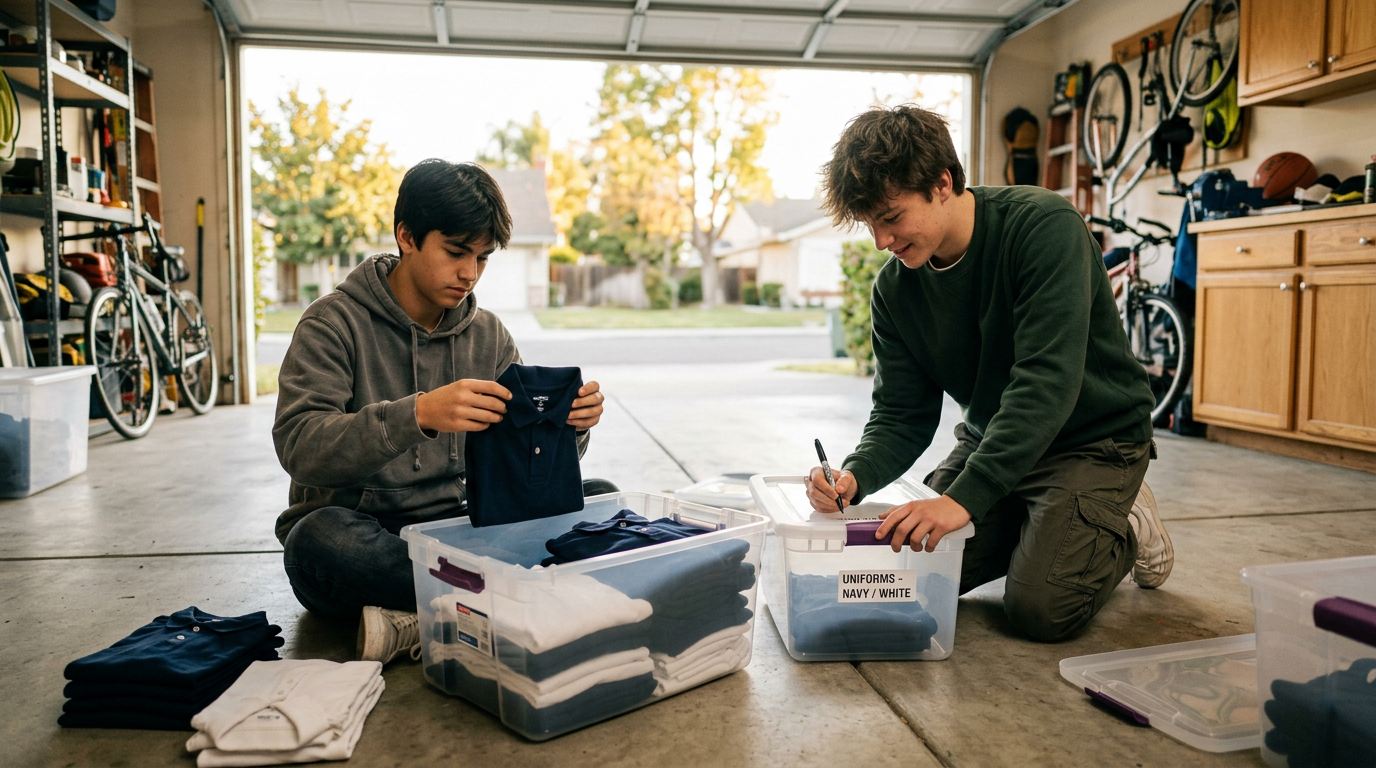
The brothers started a nonprofit out of their own garage called HOPE, which stands for Help Our Mother Earth. The idea was simple. Collect uniforms that families had outgrown. Redistribute them to families who needed them. Use the bins at school offices as the drop-off and pickup spots.
Two kids. One garage. Stacks of plastic chests full of folded clothes.
Last count, they had saved roughly 1,400 families about $140,000 in uniform costs. They had kept about 13,000 pieces of clothing out of the trash. That is around 30 tons of methane they prevented from ever going into the air. Their work runs through nine public schools in the San Mateo-Foster City School District now, all from that one moment of noticing something other kids walked past.
Their school principal told the reporters she was thrilled to be part of it. Ethan picked up an award from a local foundation for what he and his brother had built.
The story is impressive. The lesson is what I want you to take with you.
This whole thing started because two kids asked one question. Not a fundraising pitch. Not a community meeting. Not a school assembly. Just a question. “Hey, why are you wearing shorts when it’s this cold out?”
That’s leadership.
People love to talk about leadership like it’s some big, dramatic thing. Like you have to be standing on a stage with a microphone or running a meeting or holding a clipboard. But that’s not where leadership starts. Leadership starts in the part most people skip.
The part where you notice.
Most folks are walking around with their heads down. Eyes on a phone. Headphones in. Brain somewhere else. They’re not actually seeing the people around them. They’re not seeing the kid in shorts on the cold day. They’re not seeing the friend who’s been quieter than usual. They’re not seeing the teammate who’s been carrying more than their share. They’re not seeing the new student who has nobody to sit with at lunch.
You can’t lead what you don’t see.
The Hua brothers saw. That was step one.
Step two was even harder. They asked. They were willing to stop being comfortable for the thirty seconds it takes to walk up to somebody and say, “Hey, you okay?” That little bit of social risk is what blocks most people from ever doing anything that matters. They’re afraid of getting it wrong. So they get nothing right.
Step three is what separates the kind people from the leaders. Kind people would have heard the kid’s answer and felt bad for him and maybe even given him a jacket. That’s good. That’s not nothing.
But the brothers didn’t stop there. They looked at one boy in shorts and thought, how many other kids are dealing with this same thing right now? They went past the one person in front of them and started thinking about everyone like him.
That’s the part I want you to chew on. Because that’s the part nobody teaches.
A lot of young people have been told that to make a difference, you need a big idea, a budget, a board of directors, an angle, a brand. None of that is true. What you need is one moment of noticing, one moment of asking, and one decision to keep moving after you have the answer.
Two brothers. A garage. Bins of folded shirts. Fourteen hundred families helped.
You don’t need to be on television. You don’t need a thousand followers. You don’t need a teacher to put you in charge of a committee. The opportunity to lead is already sitting in front of you somewhere this week. Maybe it’s a kid at your lunch table who’s been off lately. Maybe it’s a problem at your school nobody is fixing because everybody’s waiting for someone else. Maybe it’s a friend who told you something hard and you have no idea what to say.
You don’t need to know what to say. You just need to be the person who shows up.
The brothers didn’t have a master plan that morning. They had eyes, and they had nerve, and they had a heart that didn’t let them just keep walking. That’s all it took to start.
The boy in shorts has clothes now. Hundreds of other kids do too. And it all started because two regular teenagers decided that paying attention was their job.
If there is one thing I want you to walk away with this week, let it be that. Leadership begins the moment you stop walking past.
Pay attention. Then move.
If this kind of story hits you the way it hit me, you might get something real out of the book I wrote, Actions Earn Respect. It’s built around stories like the Hua brothers, young people who didn’t wait to be told they were leaders before they started acting like one. If you’re a student trying to figure out how to step up in your school, your team, or your community, you’ll find practical ground to stand on inside it.
The boy in shorts didn’t need a hero. He needed somebody to notice. Be that person this week.