
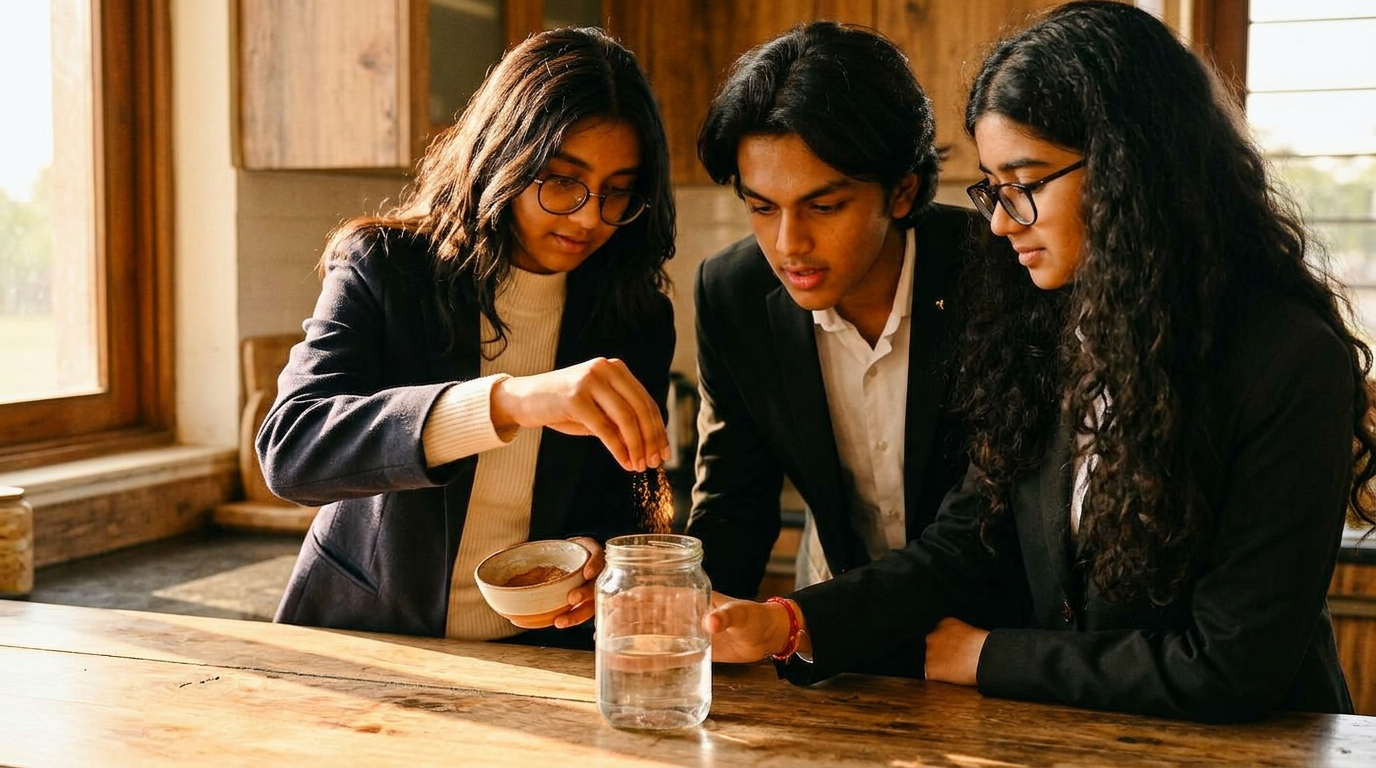
A few days ago, Good News Network ran a story I want every young person in my life to hear. It came out of India. Three sixteen-year-olds named Vivaan Chhawchharia, Ariana Agarwal, and Avyana Mehta. Friends. Classmates. Just three kids who got curious about something big.
They wanted to do something about microplastics in drinking water. That is not a small problem. Microplastics, those flecks of broken-down plastic that are far too small to see with the naked eye, have been found in the human brain. They have been found in the placenta of unborn babies. They have been recorded on the top of Mount Everest and at the bottom of the Mariana Trench. Over 2.2 billion people on Earth do not have safe, filtered drinking water. They store water in shared containers, and the plastic is in the water.
This is a famous problem. The kind of problem you would expect to be tackled by a Swiss laboratory with a billion-dollar budget and a team of PhDs. Not three teenagers with a school science class and a question.
Here is where the story gets good. The three of them looked around. They studied. They visited a rural community and watched how families actually stored their water. And the thing that finally worked was already in their kitchen. Tamarind. The same tamarind their families have used to flavor curries and chutneys for generations.
They figured out that powdered tamarind seed acts like a magnet for microplastics. You stir a little of it into a container of water. The invisible plastic particles clump together with the tamarind into something visible. Then you pull all of that out of the water with a regular handheld magnet. No electricity. No expensive filtration. No lab.
They called it Plas-Stick.
The Earth Prize, an international science competition run out of Geneva, just named their team the 2026 Asia winners. They were awarded funding to scale their invention to rural communities across India.
That is the story. Now I want to give you the leadership lesson behind it, because the lesson is bigger than the invention.
Most people, when they hear about a problem this big, do one of two things. They get overwhelmed and shut down. Or they wait. They wait for the experts. They wait for permission. They wait for funding. They wait for someone older, smarter, more credentialed to come along and fix it. That waiting room is crowded. Most people in it never get up.
These three did not wait. They did not have a fancy lab. They did not have decades of credentials. They had a school science class, a question that would not leave them alone, and a visit to a real community where they saw the problem with their own eyes. So they used what they had.
That is leadership.
Leadership is not the title. It is not the position. It is not waiting until you “have enough” to begin. Leadership is looking at the resources already in your hand, your home, your school, your friend group, and asking a different question than everyone else is asking. Not “what do I lack?” but “what could I build with this?” Not someday. Right now.
Think about your own world for a second. Your school cafeteria has a recycling habit that nobody has bothered to fix. Your team has a player who keeps getting left out. Your neighborhood has an older neighbor who cannot get to the store anymore. Your club has a fundraiser that has been the same for three years and is running out of steam. Your group chat has a friend who has gone quiet and nobody has checked on her. There is always something. There is always something on your shelf.
Most people walk by it. A leader picks it up.
You will be tempted to wait. Wait for a teacher to organize the recycling. Wait for the coach to handle the player. Wait for an adult to drive the neighbor to the store. Wait for a budget to magically appear. Wait for permission you do not actually need.
Vivaan, Ariana, and Avyana would tell you to stop waiting and start looking at what is already in your hand.
The tamarind seed had been in those girls’ homes their entire lives. It was always there. They did not invent the tamarind. They did not invent water. What they did was look at what was already in front of them and ask a different question.
They did not ask, “where can I find expensive equipment?” They asked, “what could the things I already have do that nobody has tried?”
That question costs nothing to ask. It just costs courage to actually try the answer you come up with, and to be willing to look foolish in front of people while you experiment. Most people are not willing to do that part. That is why most people are still in the waiting room.
There is one more piece of this story I want you to lock in. They did not do it alone. They were a team. Three names. Three signatures on the work. Three girls who chose to bet on each other. You do not have to be the smartest student in the room to lead something. You have to be willing to find two friends who are willing to figure it out with you. Partnership and leadership are the same muscle. One does not work without the other.
For any young person reading this who is wondering whether they are old enough, smart enough, or “ready” enough to step up and lead something in their own world, I wrote my book Actions Earn Respect with you specifically in mind. It is not theory and it is not motivational filler. It is a practical guide to spotting the openings around you and walking through them with quiet confidence. The kind of book you can read on the bus and try the next day. You can find it on Amazon.
So the next time a problem in your world feels too big for you, remember three sixteen-year-olds who looked at a global crisis and said, “we have a kitchen, we have a science class, we have each other.”
That was enough.
It is enough for you, too.
Start where you stand. With what you have. Build from there.