
Most college students can barely organize a study group.
Tessa Hefty coordinated 700 of them to raise more money in one week than most small nonprofits see in a year.
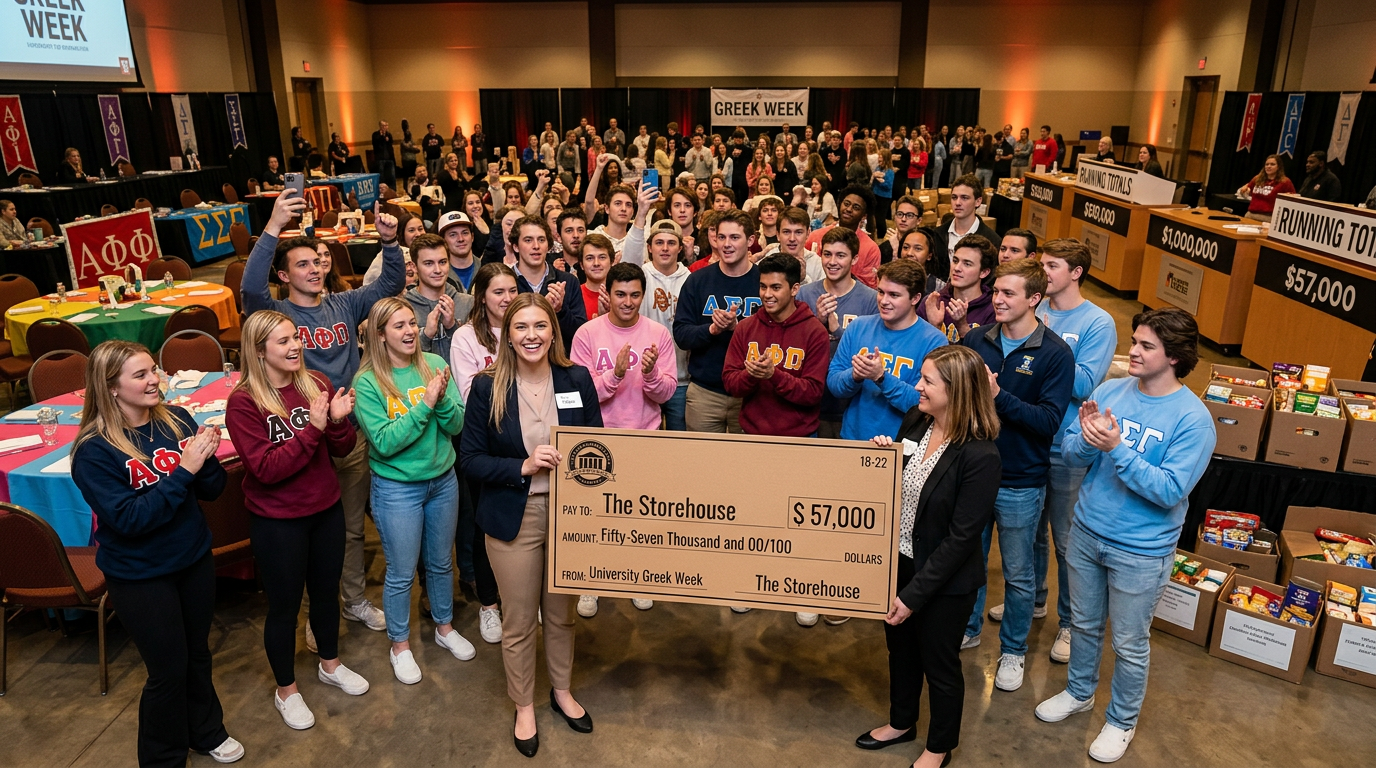
As the student chair of Greek Week 2026 at the University of New Mexico, Tessa led 19 fraternity and sorority chapters through a week of competitions designed around one goal: help Storehouse New Mexico fight food insecurity. When the final numbers came in, they had raised $57,000, collected 8,660 pounds of food, and contributed 500 hours of community service across Albuquerque.
They more than doubled what previous years had raised.
But here’s what makes this story worth paying attention to: they didn’t do it by asking everyone to be nice and work together. They did it by turning rivalry into purpose.
Greek Week at UNM has been around for decades. Every year, chapters compete in Greek Sing, trivia nights, and team challenges. There’s a winner. There’s a trophy. And for most students, that’s the point.
But Tessa and her committee made one critical decision that changed everything. They picked a cause first, then built the competition around it.
After researching food insecurity in New Mexico, they selected Storehouse as the beneficiary. Then they designed every event, every challenge, every fundraising activity to support that mission. Students competed hard because competition drives energy. But they were competing for something bigger than bragging rights.
Chris Brooks, the Student Activities advisor for fraternity and sorority life, saw the shift happen in real time. “This is the closest Greek Week has ever been in terms of competition,” he said. “But at the end of the day, Storehouse won.”
That’s leadership.
Most people think you need to choose between competition and collaboration. Either you’re trying to win, or you’re trying to help. Either people are motivated by ego, or they’re motivated by service.
Tessa’s approach shows that’s a false choice. People can be competitive and purposeful at the same time. In fact, when you channel competition toward a shared mission, you get better results than either approach alone.
The chapters didn’t stop trying to beat each other. They competed harder than ever. But instead of competing just to win, they were competing to see who could contribute the most to solving food insecurity.
That shift in framing matters.
When you’re competing just to win, the focus stays internal. Who’s ahead. Who’s behind. Who gets the trophy. But when you’re competing to maximize impact, the focus shifts outward. Suddenly the question isn’t “how do we beat them” but “how much can we raise together.”
And that’s when numbers start breaking records.
Greek Week at UNM typically raised between $20,000 and $34,000 annually. This year they hit $57,000. That’s not incremental improvement. That’s a different level of engagement.
Part of that came from better tools. They introduced a live fundraising platform that made it easier for students to reach out to family and friends. Technology helped.
But tools don’t explain doubling your results. What explains that is motivation. And motivation comes from meaning.
Students weren’t just raising money for some abstract nonprofit they’d never heard of. They learned about food insecurity in their own state. They understood the problem. They saw how their efforts connected to real families facing real hunger.
That connection changed how hard they worked.
Chapters hosted their own fundraising events. They reached out to networks beyond campus. They didn’t wait for the organizing committee to tell them what to do. They took initiative because they understood what was at stake.
Brooks said something that captures this perfectly: “This week reminds students that they are part of something bigger. We are here for the purpose of helping others, not just ourselves.”
When people feel connected to something bigger, they show up differently. They work harder. They care more. They push past what’s comfortable because the goal matters more than the effort.
And that’s exactly what Tessa organized.
Leading 700 people isn’t easy. That’s not a club. That’s not a team. That’s a small community with competing interests, different priorities, and natural rivalries.
But Tessa didn’t try to eliminate those differences. She used them. She gave people permission to compete fiercely while serving a shared mission. And because she framed it that way from the start, the competition became fuel instead of friction.
That takes skill. You can’t force that dynamic. You have to design it.
The week included Greek Sing performances, trivia competitions, team challenges. Classic Greek Week events. But every single activity was tied back to the fundraising goal. Students knew that their performance in these events translated directly into support for Storehouse.
That’s intentional design. That’s strategic thinking. That’s leadership.
And it wasn’t just about the money. Students also contributed 500 hours of community service through park cleanups and local service center support. They showed up physically. They did the work. They understood that leadership means more than writing checks.
Brooks emphasized that the impact of Greek Week goes beyond the final fundraising total. “It shows students what they are capable of,” he said. “When they see the impact they’ve made, it reinforces that their work matters and encourages them to stay engaged beyond this one week.”
That’s the real win here.
Sure, $57,000 helps Storehouse do critical work fighting food insecurity. That matters. But what matters just as much is that 700 students learned they can organize at scale, coordinate across differences, and create measurable impact when they commit to a shared purpose.
Those students aren’t going to forget that.
They now know what they’re capable of. They’ve experienced what it feels like to be part of something that actually changes outcomes for people. And they’ve seen that competition and service don’t have to be opposing forces.
That’s a lesson they’ll carry into every team, organization, and community they join after college.
The week concluded with the annual Greek banquet, where students gathered to celebrate their collective accomplishment and present the check to Storehouse New Mexico. And while individual chapters were recognized for their competitive performance, the real story was what they built together.
Brooks put it simply: “We can talk about which chapter won, but that’s not the story. The story is what this community accomplished together.”
If you’re trying to lead a group right now, whether it’s five people or five hundred, here’s what Tessa’s example shows you: don’t try to eliminate natural competition or rivalry. Channel it.
Give people something worth competing for. Frame the win as collective impact, not individual glory. Design activities where their effort directly translates into measurable good.
When you do that, people bring more energy than you thought possible. They surprise themselves with what they can accomplish. And they walk away knowing they’re capable of leading change, not just talking about it.
Tessa Hefty coordinated something most adults never attempt: organizing hundreds of people with competing loyalties around a single mission. She did it while still in college. And she delivered results that exceeded everything that came before.
That’s not luck. That’s leadership.
And it shows what becomes possible when you stop waiting for perfect conditions and start organizing the people right in front of you around a purpose that matters.
If you want to build leadership skills that translate into real-world results, I wrote a book designed for exactly that. It’s called Actions Earn Respect, and it focuses on helping students and young adults develop practical confidence through action. You can find it here: